
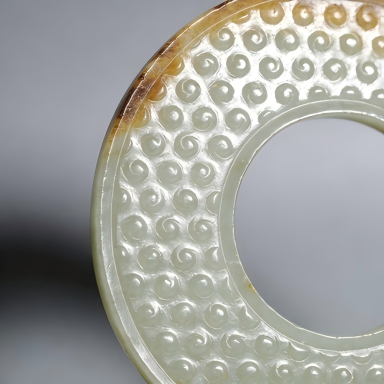
当这和田玉纹纹璧在灯光下缓缓转动, 温暖的质感与浓郁的纹理相得益彰. 先生. 陈, 经验丰富的古董玉鉴赏家, 他的目光从未离开过它. 在他看来, 这件看似普通的环形器物不仅仅是一件工艺杰作, 但也是一个 “stone-carved history book” engraved with the codes of civilization from the Warring States to the Han Dynasty.
我. Jade Quality and Patina: The Fingerprints Left by Time
“First, look at the jade quality. This is typical Hetian seed material, dense and warm to the touch, with excellent oiliness,” 先生. Chen said, lightly touching the surface of the bi with a confident tone. “See these localized brownish-yellow stains? They naturally diffuse inward from the edges with distinct layers, which is a typical sign of earth patina.”
This coloration is not artificially added later but is a secondary color formed over thousands of years of underground burial, as minerals in the soil slowly permeated the jade. “The distribution, transition, and degree of aging of the patina are highly consistent with the jade itself. This is one of the core criteria for judging the authenticity of ancient jades,” 先生. Chen explained. “Modern replicas often have patinas that float on the surface, lacking this inner transparency and the profound sense of age.”
二. Grain Pattern Craftsmanship: A Legacy of Ingenuity from Two Millennia Ago
The grain patterns covering the surface are the soul of this piece. “The grain pattern resembles plump grains of rice and was the most representative decorative motif on jade bis from the Warring States to the Han Dynasty,” 先生. Chen pointed out the details of the patterns. “Look closely. Each grain is rounded and raised, arranged neatly yet with a lively feel. This is a typical feature of manual rotary grinding.”
According to him, ancient artisans first had to position the dots with tube drills, then repeatedly grind them using abrasive sand and a rotary tool called a ‘tuo’ to achieve this effect of plump grains with uniform spacing. “Authentic grain patterns have a subtle sense of manual hesitation at their edges, whereas modern replicas made with electric tools have stiff lines and rigid arrangements.” The grain patterns on this bi are well-spaced, the background is smooth, fully showcasing the superb skill of jade craftsmen two thousand years ago.
三、. Cultural Connotations: From Ritual Object to Spiritual Symbol
“The grain pattern is by no means mere decoration. It carries the ancients’ wish for abundant harvests and is also a physical manifestation of the idea that ‘the gentleman compares his virtue to jade’,” 先生. Chen said with reverence. “During the Warring States period, the jade bi was a core ritual object for worshipping heaven and earth and for court ceremonies, symbolizing the cosmological concept of ‘heaven being round and earth being square’. The grain pattern, meaning ‘grains nourish all people,’ merged the hope for agricultural prosperity with the admiration for a gentleman’s virtuous conduct.”
The shape of this bi is regular, with raised inner and outer rims, conforming to the typical standards of ritual jades from the Warring States and Han periods. “It likely once belonged to a member of the aristocracy, serving as both a status symbol and a spiritual anchor,” 先生. Chen said. “When we gaze upon these grain patterns, it is as if we can touch the awe the ancients held for nature and their yearning for a better life, two millennia ago.”
四号. Collecting Value: The Weight of Civilizational Heritage
In the collector’s market, Warring States and Han grain-patterned jade bis are always highly sought-after treasures. But in Mr. Chen’s eyes, their value extends far beyond money. “A true collector values not the price, but the civilizational heritage it carries,” he said. “This bi has been passed down for a thousand years, from a slumber underground to its reappearance in the present world. Its very existence is a story of civilizational transmission.”
“Its value lies in allowing us to transcend time and space, to converse with the ancients, and to feel the unbroken continuity of Chinese civilization,” 先生. Chen concluded. “Collecting is not about possession, but about preservation—preserving these fragments of civilization so they may continue to tell our nation’s past and spirit to future generations.”
Under the expert’s interpretation, this grain-patterned jade bi is no longer a cold object, but a vivid piece of history, a weighty legacy of civilization, quietly radiating eternal light through the ages.